

Two bottles sat on my kitchen counter for a month, side by side next to the coffee maker: a fish oil and a krill oil. I am 61, I teach two low-impact strength classes a week at our rec center, and I walk about three miles most mornings with a group that does not slow down for me. I wanted to know which of the two I would still be taking in week four. Short answer: Nordic Naturals Ultimate Omega is the bottle I keep buying. The krill oil was not a bad product. Two of those small capsules simply gave me a fraction of the omega-3 that two fish oil softgels do, and I got tired of doing capsule math before breakfast.
Here is what I am not going to do. I am not going to tell you one of these is a waste of money. They are both omega-3 supplements, they both have real use, and the right one depends on what you are trying to get and how you feel about swallowing pills. What separates them comes down to four things: dose per serving, pill size, what else rides along in the capsule, and what you pay for each gram of EPA and DHA. I ran that comparison at my own counter and then carried both labels to my pharmacist. I am a retired PE teacher, not a doctor, and nothing here is medical advice. If you take a blood thinner, if you have surgery coming up, or if you take anything on a daily schedule, check with your doctor or pharmacist before you add either one. That goes double for a shellfish allergy, and I will get to why. I also want to say up front that I have a shelf in the pantry of half-finished bottles that did not survive week four, so my standard for keeping something is not what the label promises. It is whether I still reach for it on a Thursday morning when I am running late for class.
| Nordic Naturals Ultimate Omega | Krill Oil | |
|---|---|---|
| Omega-3 per serving | 1,280 mg of combined EPA and DHA | Usually far less, often 100 to 150 mg per capsule |
| Form | Triglyceride-form fish oil concentrate | Phospholipid-form krill oil |
| Pill size | Softgel, two per serving | Small softgel, easy to swallow |
| Servings per bottle | 30 servings in a 60-softgel bottle | Varies widely by brand, read the label |
| Flavor | Lemon | Usually unflavored |
| Natural antioxidant along for the ride | None added beyond the oil | Astaxanthin, naturally present |
| Allergen note | Fish. Not for a fish allergy. | Shellfish. Not for a shellfish allergy. |
| Cost per gram of EPA and DHA | Lower | Higher |
| Research behind the category | Decades of trials on heart, brain and eye outcomes | Smaller body of research, some promising absorption work |
| Best for | A solid daily dose in two softgels | People who want small pills and are fine with a lower dose |
Where Nordic Naturals Wins
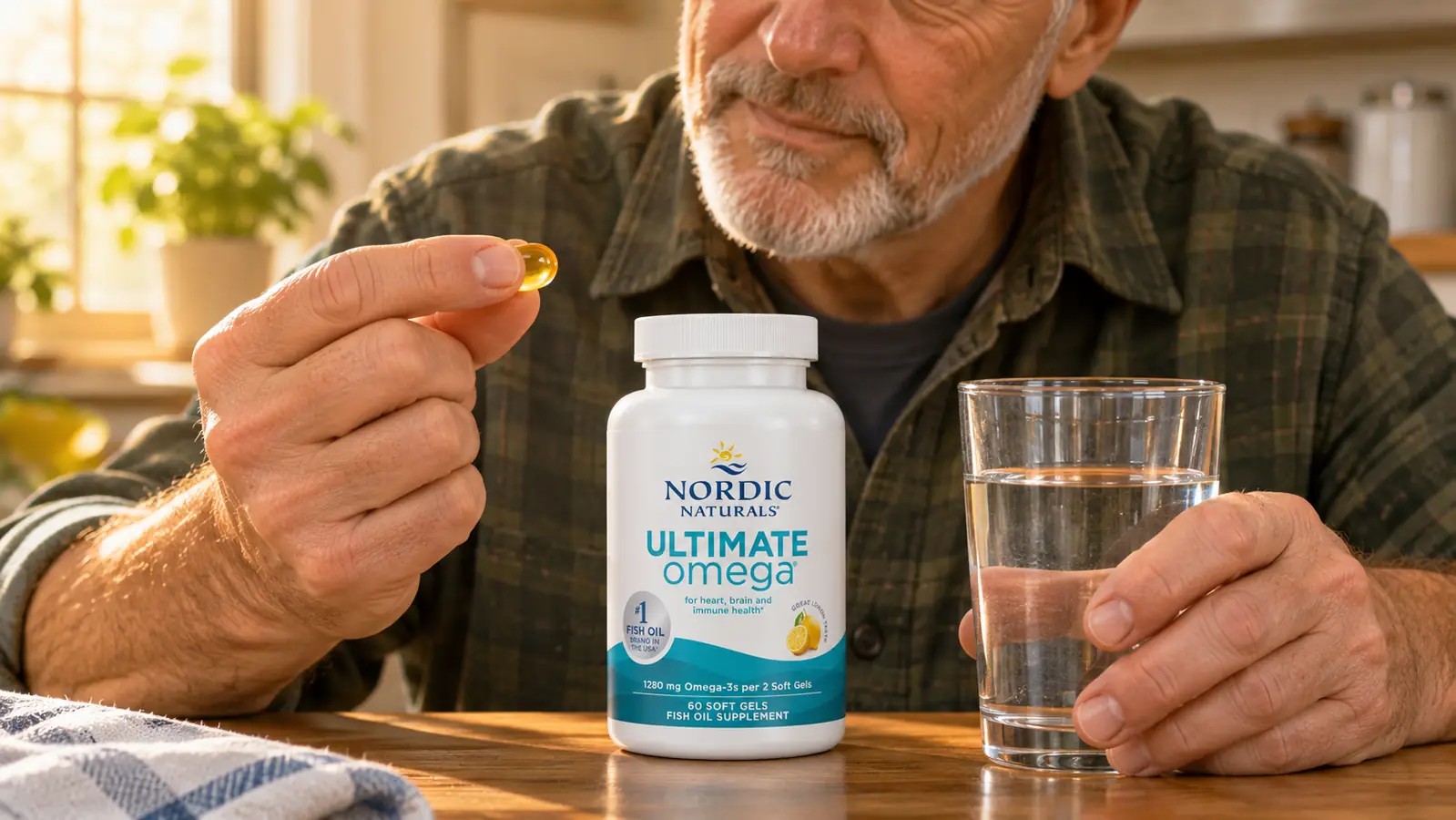
The dose is the first thing, and it is not close. Nordic Naturals puts 1,280 mg of combined EPA and DHA in a serving, and a serving is two softgels. The bottle holds 60 softgels, which the label lists as 30 servings. That is one bottle, one month, two softgels a day. I do not have to count anything or stack capsules on a saucer. The krill oil I compared it to carries a small amount of omega-3 per capsule, usually somewhere in the 100 to 150 mg range depending on the brand, so matching that 1,280 mg takes a serious handful. I did the counting myself one Tuesday morning, because I did not believe the arithmetic until I saw it with my own eyes. I shook the krill capsules out onto a saucer beside my coffee cup and lined them up in little rows like checkers. Six capsules in, I still had not reached the number printed on the fish oil label, and I had a small pile of softgels sitting there looking back at me. I swept them into my hand, put them back in the bottle, and went to teach my class. That was the end of that experiment.
The second thing is cost per gram of omega-3. Krill oil costs more per milligram of EPA and DHA, and it is not a small difference. Part of that is the capsule carrying less of the thing you came for. Part of it is the fishery, which is small, tightly managed and expensive to work with. I am not going to pretend that is fair to krill, but it is the math I have to do on a retired teacher's grocery budget. The third thing is the label details I actually use. These softgels are lemon flavored, they are in the triglyceride form, and they are gluten free and non-GMO. I take two with breakfast and I have not had a fishy repeat afterward, which was my one real worry going in.
I am skeptical of supplement marketing by nature. I read labels out loud and my husband Walt leaves the room. What got me to reorder this one was not a claim on the front of the box. It was the match between servings and softgel count, the gluten free and non-GMO notes, and the fact that after two months I had not missed a day, which is more than I can say for the powder tubs in my cabinet. The first bottle ran out on a Sunday. I set the empty on the counter and looked at it for two days before I ordered the next one, which around here counts as a strong endorsement. Sixty thousand ratings at 4.7 stars is not proof of anything, but it does tell you a lot of people kept buying it.
Where Krill Oil Wins
Small pills. That is the honest answer, and it matters more than people admit. The krill capsules went down easily, and if you have a narrow throat or you already take four other things with breakfast, a smaller capsule is a real quality of life difference. I noticed it. Krill oil also brings astaxanthin along naturally, an antioxidant you do not get in a plain fish oil softgel. And some people who burp fish oil all afternoon tell me krill does not do that to them. The form is interesting too. Krill oil is phospholipid form, and there is research suggesting it may be absorbed differently, though that research is not settled and the studies do not always use the doses you find in a bottle.
Where krill oil loses for me is everything downstream of that small capsule. If your goal is a meaningful daily dose of EPA and DHA, you are signing up for a lot of capsules, and the cost per gram climbs with every one. The evidence base is thinner than fish oil's, which has decades of trials behind it on heart, brain and eye outcomes. Krill oil also comes from shellfish, so if you react to shrimp or crab, this is not a supplement to experiment with on your own. I asked my pharmacist about that directly, standing at the counter with both bottles in my tote bag, and she did not hesitate: with a shellfish allergy, krill is off the table, and fish oil is the one to ask about instead. On sourcing, the Antarctic krill fishery is carefully watched, so look for a certification on the bottle before you buy. I looked at the label on the one I tried and found a certification mark, which is a good sign, but it is not an argument for taking eight capsules a day. None of that makes krill a bad choice. It makes it a narrower one.
Two softgels, 1,280 mg of EPA and DHA, 30 servings in the bottle. That is the whole reason I reordered.
If the dose is what you came for, this is the bottle on my counter
60 softgels, 30 servings, 1,280 mg of combined EPA and DHA per serving, lemon flavored, gluten free and non-GMO. It holds a 4.7 star average across 60,870 ratings. Ask your pharmacist before you add it to anything else you take.
Amazon Check Today's Price on Amazon →
What the Labels Actually Say
Reading these two labels out loud in my kitchen, which I do, taught me more than any ad. The number to look for is not how many milligrams of oil are in the capsule. It is milligrams of EPA and DHA. A bottle can shout 1,000 mg of fish oil on the front and carry a fraction of that in the fatty acids you are actually after. Serving size is the second trap. A serving is not a capsule. Here it is two softgels, and the bottle says 30 servings, so a 60 count is a 30 day bottle. Krill labels usually list a smaller serving with a much smaller EPA and DHA total, and those totals swing a lot from brand to brand, so read each one instead of assuming. I made that mistake at first. I read the big number on the front of the krill bottle, felt pleased with myself, and then put on my reading glasses and found the actual EPA and DHA line in small print near the bottom of the panel. It was a fraction of what I assumed. I stood there in my own kitchen feeling like a woman who had been sold a story.
The third thing I check is the form the oil is in. Fish oil concentrates are sold in triglyceride form or ethyl ester form, and the triglyceride form is the one the listing says is used here. Krill is phospholipid form, a different delivery system entirely, and the reason people argue about it. The fourth thing is the rest of the ingredient list. The fifth is whether the brand publishes its test results, because in both categories some do and some do not. Then I flip the bottle over for allergens. Fish oil is fish. Krill oil is shellfish. If you have a shellfish allergy, that single line settles the whole comparison for you before you look at anything else. I took both bottles to the pharmacy counter at the grocery store on a Wednesday and asked my questions in a quiet moment, when nobody was waiting behind me. If you do the same, bring the actual bottles. The pharmacist read the panels faster than I did and pointed at a line I had walked right past.
Who Should Buy Which
Choose the Nordic Naturals fish oil if your goal is a solid daily dose of EPA and DHA without a pile of capsules, if cost per gram matters to you, and if you want a supplement with decades of research behind the category. Two softgels with breakfast, one bottle a month, done. Choose krill oil if small pills are the deciding factor for you, if you already know you tolerate it, if you like the idea of the astaxanthin that comes along with it, and if a lower omega-3 dose per capsule fits what your doctor suggested. It is also a reasonable choice if you have tried fish oil and could not get past the aftertaste, though I would still run it past your pharmacist first. For me the deciding moment was small and unglamorous. It was a Thursday in April, I had a class to teach at nine, and I had two bottles on the counter. I reached for the one that took two softgels instead of eight, and I did not have to think about it, which is how I know a routine will last. It has been on my counter tray next to the coffee maker ever since.
One more thing, and I mean this the way I mean it when I say it to my Tuesday class. Neither of these is going to fix your knees, your memory or your blood pressure on its own. An omega-3 supplement sits on top of the walking, the lifting, the vegetables and whatever your doctor has you on. Not in place of any of it. I take mine because my doctor and I talked about it, and I keep taking it because the routine is easy enough that I do not skip it. My knee is still stiff on cold mornings and I do not expect a softgel to change that. That is the only test that matters in the end.
Two softgels with breakfast. Thirty days. That is the whole routine.
Nordic Naturals Ultimate Omega, 1,280 mg of combined EPA and DHA per serving, lemon flavored, gluten free and non-GMO. If you take any medication, run it past your pharmacist first.
Amazon Check Today's Price on Amazon →